20 Living Books for Black History Month (Elementary Homeschool)
- lisa thornton
- Dec 29, 2025
- 3 min read

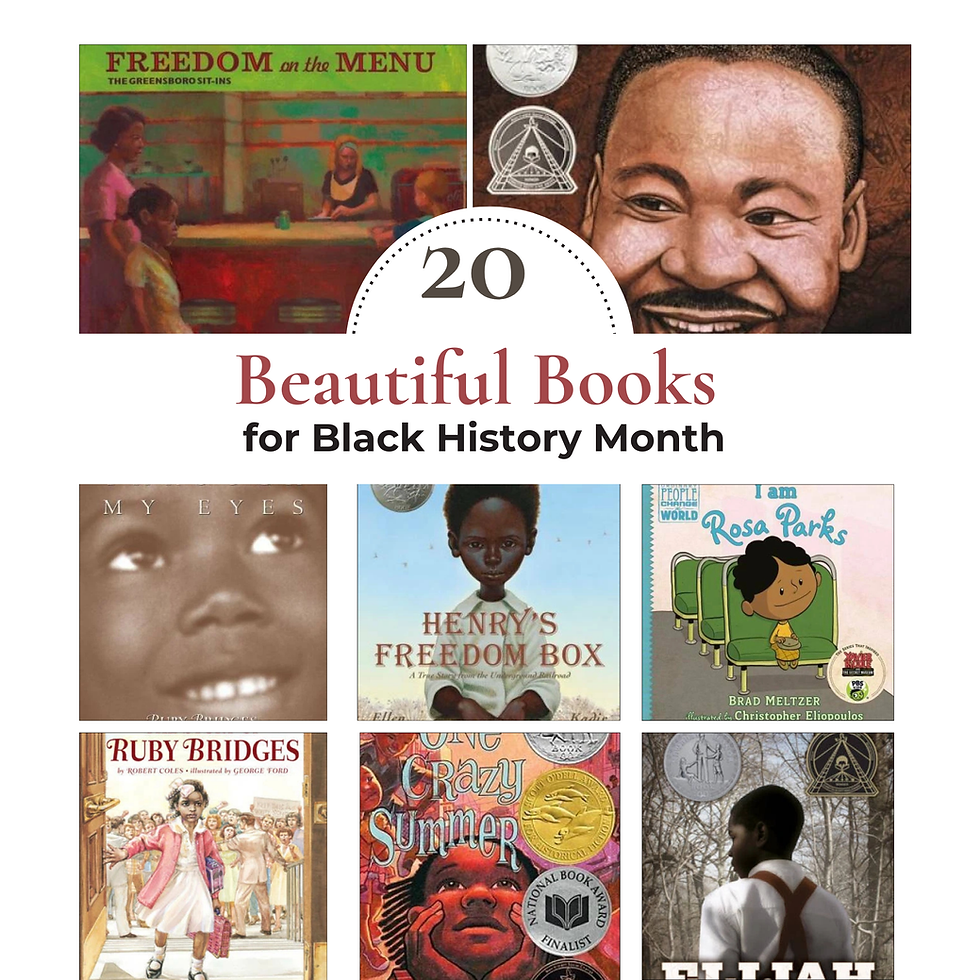
Black History Month is a meaningful time to read together and learn through stories. For elementary-aged children especially, history often makes the most sense when it is experienced through living books — books that tell true stories with heart, narrative, and depth.
Whether you homeschool one child or multiple ages, reading aloud allows children to listen, ask questions, and slowly build understanding together. This list includes picture books, biographies, narrative nonfiction, and historical fiction that work well for elementary homeschool families studying Martin Luther King Jr., the Civil Rights Movement, and broader Black history.
For families who prefer to pair reading with structured activities, I also created a Martin Luther King Jr. unit study that complements many of these books and allows children of different ages to engage at their own level.(You can view the unit here if helpful!)
Picture Books (Ideal for Read-Alouds & Younger Elementary)
Martin’s Big Words by Doreen Rappaport
Introduces Martin Luther King Jr. through his own words, paired with expressive illustrations.
The Story of Ruby Bridges by Robert Coles
A gentle, first-person account of courage during school desegregation.
I Am Rosa Parks by Brad Meltzer
A clear and accessible introduction to Rosa Parks for younger readers.
Freedom on the Menu by Carole Boston Weatherford
Explains the Civil Rights Movement through the eyes of a child.
Henry’s Freedom Box by Ellen Levine
A powerful true story of perseverance and hope.
Sit-In by Andrea Davis Pinkney
Uses rhythmic language to explain peaceful protest and sit-ins.
Let the Children March by Monica Clark-Robinson
Highlights the important role children played in the Civil Rights Movement.
Freedom Summer by Deborah Wiles
A story of friendship during desegregation.
Before She Was Harriet by Lesa Cline-Ransome
A lyrical look at Harriet Tubman’s life and bravery.
Narrative Nonfiction & Biographies (Elementary Level)
Who Was Martin Luther King Jr.? by Bonnie Bader
A straightforward biography well suited for independent readers.
Who Was Rosa Parks? by Yona Zeldis McDonough
Expands understanding of Rosa Parks beyond one moment in history.
Through My Eyes by Ruby Bridges
Best for upper elementary; reflective and personal.
Child of the Civil Rights Movement by Paula Young Shelton
A firsthand account from the daughter of civil rights leaders.
Malcolm Little by Ilyasah Shabazz
Introduces Malcolm X’s early life in an age-appropriate way.
Historical Fiction (Upper Elementary)
The Watsons Go to Birmingham – 1963 by Christopher Paul Curtis
A moving family story set during a pivotal moment in the Civil Rights era.
Elijah of Buxton by Christopher Paul Curtis
Explores freedom and courage through story.
One Crazy Summer by Rita Williams-Garcia
Follows three sisters during the Civil Rights Movement.
Celebrating Broader Black History & Achievement
Mae Among the Stars by Roda Ahmed
An inspiring story of Mae Jemison and dreaming big.
Carter Reads the Newspaper by Deborah Hopkinson
Celebrates curiosity, literacy, and early Black achievement.
The Undefeated by Kwame Alexander
A poetic tribute to resilience, history, and hope.
Using These Books in Your Homeschool
Many families choose to:
read aloud daily during morning time
discuss ideas together without written work
allow older children to journal or research further
revisit these books year after year
Younger children can listen and narrate orally, while older children begin to connect events, ideas, and themes more deeply.
Pairing Books With a Unit Study
For families who appreciate having discussion questions, timelines, vocabulary, and hands-on activities ready to go, these books pair naturally with a Martin Luther King Jr. unit study designed for multi-age homeschool learning.
The unit allows older children to reflect and extend learning, while younger children participate through hands-on activities connected to the same themes.


.png)


Comments