How Do We Teach Science at Home Without a Heavy, Daily Science Curriculum?A Gentle, Nature-Based Approach for the Early Years


For many homeschool families, science feels like the subject that tips the day from peaceful into overwhelming.
When we picture teaching science, we often imagine textbooks, experiments that require preparation, and lesson plans that must be followed carefully to “do it right.” For families with young children—especially in the preschool through early elementary years—this kind of structure can quickly become discouraging.
But here is something many homeschool moms discover with time:
In the early years, science does not need to be a large, daily, tightly planned subject in order to be meaningful.
Science can be learned gently—through nature, conversation, reading, and simple observation—without losing depth or purpose.
Do you need a fully planned science curriculum in the early years?
What most families are really asking is not whether science matters, but whether it needs to be scheduled, scripted, and taught every day to “count.”
In the early years, science learning happens naturally through:
noticing the world around us
asking questions
observing patterns and change
spending time outdoors
reading thoughtful books
When science becomes overly structured too early, it can crowd out curiosity. Young children often learn best when they are given time to notice and wonder before being asked to master terminology or complete assignments.
In many parts of the world, early childhood education reflects this understanding. In Denmark, for example, children typically begin compulsory schooling in the year they turn six, and the years before that are largely focused on play, social development, and outdoor experiences. Academic expectations are introduced gradually rather than rushed.
This perspective offers reassurance: children are capable of deep learning without constant formal instruction—and slowing down does not mean falling behind.

The power of nature study in early science learning
Nature study is one of the most gentle and effective ways to support science learning in the early years.
Rather than learning about science only through books or worksheets, children learn from direct experience. They observe plants, animals, weather, and seasonal change firsthand, building understanding through repeated encounters with the natural world.
Nature study encourages children to:
pay attention
make connections
develop vocabulary naturally
build habits of careful observation
This approach has deep roots in educational philosophy and has long been valued as a meaningful way to introduce science to young learners.
A huge advocate of nature study in early learning was Charlotte Mason
A huge advocate of nature study in early learning was Charlotte Mason (1842–1923), a British educator whose ideas continue to influence homeschooling today.
Charlotte Mason believed that children are whole persons, capable of thoughtful attention and genuine curiosity. She emphasized education that nourishes the mind and spirit through rich ideas rather than rote instruction. Nature study, in her philosophy, was not an extra subject—it was a foundation.
She encouraged children to spend regular time outdoors observing the natural world closely: noticing the shape of a leaf, the behavior of an insect, the pattern of clouds, or the change of seasons. Nature itself, she believed, was a living textbook.
Alongside nature study, Charlotte Mason also emphasized reading living books, practicing narration, and keeping lessons short and meaningful. Her approach supports the idea that science in the early years does not need to stand alone as a heavy subject, but can grow naturally alongside reading, language, and daily life.
What does nature study look like in the early years?
Nature study does not need to look elaborate or impressive.
For young children, it often looks like:
watching ants move along a path
noticing how leaves change color
listening for birds during a morning walk
collecting pinecones, stones, or acorns
observing clouds or rainfall
You do not need to explain everything. Often, the most meaningful moments come from noticing together.
What do you see?What feels different today?What do you wonder about?
These simple questions quietly build the foundation for scientific thinking.
Science woven into early language arts and math
One of the great gifts of early learning is that subjects do not need to be divided into separate boxes.
Science naturally weaves into early language arts and math when learning is rooted in the natural world. This might look like:
A is for acorn, B is for butterfly
counting pinecones or stones to ten
sorting leaves by size or color
noticing shapes found in nature
creating simple patterns with natural materials
Early science lives comfortably alongside alphabet learning, early phonics, counting, number sense, and pattern recognition. Rather than adding another subject to manage, science becomes part of a connected whole.
The beauty of preschool and early elementary learning is that everything can be connected through a single theme—and nature provides endless opportunities to do just that.
A gentle resource for early learning through nature
When science is woven into early language arts and math, learning begins to feel connected rather than compartmentalized.
My Early Learning Nature Bundle was created to make this kind of connected learning simple to bring into your days. It brings science, early literacy, and math together through hands-on, nature-inspired activities—alphabet tracing cards rooted in the natural world, nature numbers for early counting, shapes found in nature, butterfly pattern matching, and other gentle resources designed to support observation, connection, and curiosity.
These materials are designed to work alongside nature study, reading aloud, and everyday exploration, giving you a clear and beautiful way to connect early learning through one theme without adding pressure.

Learning science through the seasons
Seasonal rhythms also offer a natural structure without requiring daily lesson plans.
In autumn, children notice falling leaves, seed pods, migrating birds, and cooler air. In winter, they observe bare trees, animal tracks, snow, and ice. In spring, they watch buds open, insects return, and rain nourish the ground. In summer, they explore gardens, water, heat, and long days.
The seasons quietly provide a sense of order and progression—without overwhelm.
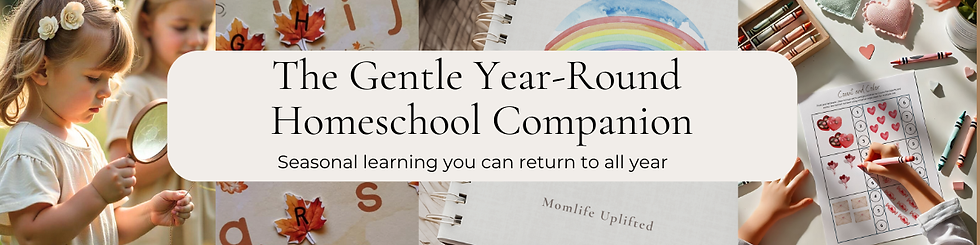
If you would love a gentle, ready-to-use way to follow the seasons with science-rich learning, my Gentle Year Homeschool Bundle was created for exactly this. It’s a year-round collection of seasonal unit studies designed to support family-style learning with structure that still leaves room for real life.
Helpful tools: books that support gentle science learning
Books play an important supporting role in early science learning. Rather than relying on a single daily science textbook, many families build a small “science shelf” of rich, well-written books to read slowly over time.
Here are several trustworthy, well-loved options that pair beautifully with nature study and early learning:
The Story-Book of Science by Jean-Henri Fabre
A large, narrative-style book that presents natural history through storytelling. Fabre introduces topics such as insects, animals, weather, and natural phenomena through conversations and observations that feel personal and engaging rather than instructional. It’s the kind of book you can read slowly over time, letting it spark questions and outdoor exploration.
Let’s-Read-and-Find-Out Science (series, various authors)
A long-trusted science picture book series created for young learners. Titles introduce real science concepts in clear language with engaging illustrations. These books are wonderful for nature-based learning because they connect beautifully to everyday observations—plants, animals, weather, the human body, magnets, and more.
DK Eyewitness books (DK / Dorling Kindersley)
These visually rich nonfiction books are packed with photographs and clear explanations. They are often used as reference books rather than daily lessons, making them perfect for curiosity-led science. When a child asks a question about space, animals, or the human body, Eyewitness books are an excellent place to explore together.
Usborne Look Inside Your Body (Usborne)
An interactive, lift-the-flap nonfiction book that introduces how the human body works. The visuals make anatomy and body systems approachable for young children, and it naturally invites conversation and wonder.
Christian Liberty Nature Readers (Christian Liberty Press)
Gentle nature-themed readers that support early literacy while introducing nature topics. These can be especially helpful if you want science and reading to work together naturally.
The animal stories of Thornton W. Burgess (Thornton W. Burgess)
Classic narrative animal stories that gently weave in natural history. Burgess’s books introduce children to animal behavior, habitats, and seasonal change through memorable characters and storytelling, making them an enjoyable companion to nature walks and observation.
Books like these help science feel relational and accessible. They deepen understanding without turning science into a rigid subject.
At the end of the day, science in the early years does not need to be complicated. A handful of rich books, time outdoors, and a habit of noticing are powerful tools.
Common questions about teaching science at home
What if I don’t feel confident teaching science?
You do not need to be an expert. Learning alongside your children models curiosity and humility, which are powerful teachers in themselves.
What if we miss something important?
In the early years, depth matters more than coverage. Observing a few things closely often leads to deeper understanding than rushing through many topics.
How often should we do science?
When science is woven into daily life, it does not need a set schedule. A few moments of noticing each day is enough. As each year progresses you'll spend more and more time in foraml learning...let the first years be years of wonder...Stay outside and play with natural elements and suddenly your "science" time will be longer than you expected!
When does more formal science make sense?
Many families gradually introduce structured science later, once reading, writing, and sustained attention are more developed.
You’re allowed to keep science simple
If science feels heavy right now, that is not a failure—it is information.
The early years were never meant to be rushed.
When children are given time to observe, wonder, and explore, they build a strong foundation for future learning—one rooted in curiosity, confidence, and joy.
Science does not need to be another subject to manage.It can be a way of seeing the world together.


.png)


Comments