Do You Need a Homeschool Curriculum for Preschool–3rd Grade?

Updated: Feb 8
A Gentle, Real-Life Answer for Overwhelmed Moms

If you’ve ever found yourself staring at homeschool curriculum options late at night, tabs open everywhere, wondering if this one decision will somehow determine your child’s entire future — you are not alone.
So many moms feel the weight of getting it right, especially in the early years. You want learning to feel meaningful. You want your days to feel peaceful. You want your children to love learning. And yet, between dishes, diapers, toddler interruptions, and older kids’ lessons, it can all feel like too much.
One of the most common questions I hear from moms just starting out is this:
Do I actually need a homeschool curriculum to homeschool well?
Let’s take a deep breath and talk honestly about it.
So… do you need a homeschool curriculum?
The short answer is no — a formal homeschool curriculum is not required, especially in the preschool and early elementary years.
Many families homeschool successfully with very little structure at first. In fact, young children learn best through everyday life: conversation, stories, play, and time outdoors.
That doesn’t mean curriculum is bad. It simply means it’s a tool, not a requirement — and certainly not the measure of whether you’re doing a good job as a homeschool mom.
What children really need in the early years
When we strip away the pressure, the early years become much simpler than they’re often made out to be.
Preschool
At this stage, children learn primarily through:
play and exploration
listening to stories
language-rich conversation
hands-on activities
time outside
simple, predictable routines
Preschool doesn’t need long lessons or worksheets. It needs space to wonder, move, and connect.
Kindergarten
As children grow, gentle structure can slowly be introduced:
exposure to letters and sounds
counting and number sense
daily read-alouds
fine motor practice
curiosity-driven learning
This can still be relaxed and relationship-focused.
1st–3rd Grade
In the early elementary years, learning deepens:
reading practice through quality books
math concepts built gradually
writing through copywork and narration
history and science through stories
nature study and observation
Learning doesn’t need to look like school to be effective.
Common curriculum mistakes homeschool moms make
This is where many well-intentioned moms get tripped up.
Some of the most common mistakes I see are:
buying too much curriculum too quickly
choosing rigid programs out of fear
trying to recreate public school at home
switching approaches constantly because of doubt
measuring progress by comparison
None of these mean you’re failing — they usually mean you care deeply.
How we homeschool in our home
In our homeschool, we’ve always leaned toward a gentle, family-style approach. With multiple ages learning together, flexibility isn’t optional — it’s necessary.
Our days aren’t perfect or quiet. Toddlers interrupt lessons. Some mornings move slowly. Some plans get scrapped altogether.
But learning still happens.
We focus on:
shared read-alouds
simple daily rhythms rather than rigid schedules
living books instead of heavy textbooks
seasonal learning that follows the natural year
faith, conversation, and connection woven into everyday life
Over time, I learned that consistency matters more than complexity — and peace matters more than perfection.

When a curriculum can be helpful
While curriculum isn’t required, it can be supportive — especially in certain seasons.
Some families find curriculum helpful when:
they’re feeling overwhelmed and want guidance
they’re teaching multiple ages at once
they want ideas laid out without daily planning
they’re slowly adding more formal learning, like math or phonics
The key is choosing resources that support your homeschool rather than control it.
A gentle option for ongoing support
As our family grew, I found myself wanting something that held onto this same gentle spirit — even as we slowly began adding more formal math and phonics into our days.
I didn’t want to lose the beauty, the breathing room, or the sense of wonder just because learning started to look a little more structured.
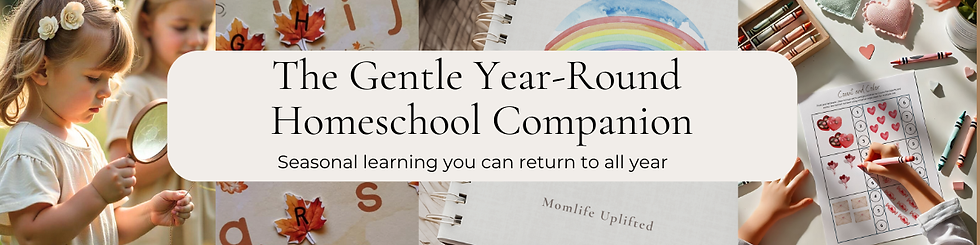
That’s why I created the Gentle Year Round Homeschool Bundle.
It isn’t a rigid curriculum. It’s a thoughtfully curated collection of seasonal unit studies designed to:
support learning without overwhelm
work well for multiple ages learning together
encourage family-style learning
leave room for flexibility and real life
It’s there for moms who want guidance, beauty, and breathing room — not pressure.
Click the picture to learn more!
Frequently asked homeschool questions
Is homeschool curriculum required by law?Homeschool laws vary by state, but curriculum itself is generally not required. We homeschool in New York — a state known for being highly regulated — and even here, the focus is on having a plan for learning, not on using a specific curriculum. The curriculum you choose is entirely up to you. As long as you can document and record your learning, you can homeschool — or even unschool — in a way that fits your family.
How long should homeschool take each day?In the early years, often far less time than traditional school. When learning is woven naturally into daily life through reading, conversation, play, and hands-on experiences, it doesn’t need to be confined to long lesson blocks. 30 Minutes a day of structured learning is enough for preschool and kindergarten...By structured I mean intentionally focusing on learning a skill like math or phonics. Your child will be learning so much more than that through unstructured play, reading, time in nature, helping you with tasks, and all the other things woven into their day.
Can I mix homeschool styles?Absolutely. Many families naturally blend approaches over time, pulling from different philosophies as their children grow and their needs change.
What if my child learns faster or slower than others?One of the greatest gifts of homeschooling is the freedom to move at your child’s pace. Children develop skills on different timelines, and homeschooling allows you to meet them where they are without pressure or comparison.
Can I change our approach mid-year?Yes — and this is one of the beautiful freedoms of homeschooling. We’ve used what worked for our family and let go of what didn’t. Even within the same household, different children often need different approaches. The math that worked beautifully for my oldest two girls did not work for my third daughter — and that’s okay. Homeschooling allows you to adjust, pivot, and respond to each child as an individual.
You don’t have to have it all figured out
If you’re standing at the beginning — or even in the middle — of your homeschool journey feeling unsure, please know this:
You don’t need the perfect curriculum.You don’t need every answer.You don’t need to rush.
You’re allowed to start gently, grow slowly, and adjust along the way.
And you don’t have to do it alone 🤍


.png)


Comments